
Module 1 · 20 min
The distance between data and decision
The gap, named and measured.
Watch & reflect · optional
The best stats you’ve ever seen
TED · Hans Rosling · External learning resource
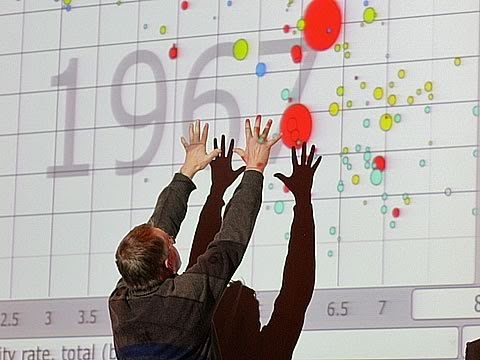
Rosling shows how evidence can challenge assumptions. This talk complements the module; it does not teach Onetsa’s decision calendar. The historical examples are not current sector statistics.
Which assumption in your next management meeting could be tested with evidence?
The hook
A provincial health office collects facility reports every month. They have done so for eleven years. The data is on a server, in a dashboard, and in a quarterly bulletin that goes to the Ministry.
In March the office has to decide how to distribute a constrained commodity budget across twenty three districts. The decision is made in a meeting on the 14th. The data that would answer the question, which districts are running out, and how fast, is available on the 26th, when the monthly cycle completes.
Nobody failed. The data team hit their deadline. The dashboard worked. The decision was still made on the basis of who argued most persuasively in the room, because the evidence arrived twelve days after it could have mattered.
This is not a data problem. It is a timing problem that looks like a data problem, and no amount of additional technology fixes it.
The core idea: decisions have windows
A decision window is the period in which a choice is genuinely open. Its closing date may precede formal approval, so ask the people involved when options can still change.
Evidence has an arrival time. A decision has a window. Compare them to check whether the evidence can be considered in time.
A reporting calendar describes when information is produced. A decision calendar describes when it can be used. Mapping both helps identify a timing gap without assuming every institution has the same problem.
The chain, and where it actually breaks
Use these five links to investigate your own institution. A gap may sit in collection, governance, routines, decision authority or the connection to public outcomes. The illustrated break is one possibility, not a finding about your team.
Choose a recent decision and trace the evidence from its source. Who checked it? Who received it? When could they still act? Compare this account with where investment has gone.
Why more technology does not close this gap
A data platform makes information accessible. Its value also depends on the people, rules and routines around it.
Before commissioning one, agree:
- which decisions it should inform
- who is responsible for those decisions
- what evidence they need
- when and how that evidence must reach them
Software can automate delivery and support review, including through AI. It cannot by itself establish lawful authority, resolve conflicting incentives or guarantee that a recommendation is used.
This complements the work of technology partners. A clear decision process gives them a better specification and a practical test of whether the platform works.
The tool
List the important decisions your unit expects to make over the next ninety days. Include decisions about resources, policy or a change of course, rather than every meeting.
- Who decides? Name the accountable person or body and the roles involved in preparing and approving the choice.
- When does the window close? Record when options stop being open, which may differ from the formal approval date.
- What evidence could change the choice? Name a finding and the action it would inform.
- Leave a field blank if you do not know. Treat it as a question to investigate, not a failure.
The tool · Decision calendar
| The decision | Who actually decides | Window opens | Window closes | What evidence would change it | |
|---|---|---|---|---|---|
Saved on this device as you type. It comes back in your systems brief at the end.
Onetsa · The Decision Window · Module 1
Decision calendar
| The decision | Who actually decides | Window opens | Window closes | What evidence would change it | |
|---|---|---|---|---|---|
onetsa.co · info@onetsa.co
What to take away
- Check each link between data and a decision; do not assume the gap is collection.
- Compare reporting dates with the period in which a decision can change.
- Technology supports access. Responsibilities and routines determine whether evidence is used.
Check your understanding
Nothing here is recorded and there is no score. The questions are for you.